
The Latest From Tina
Whether you're evaluating an acquisition, planning a renovation, repositioning a property or developing from the ground up, smart design decisions begin with the right information.
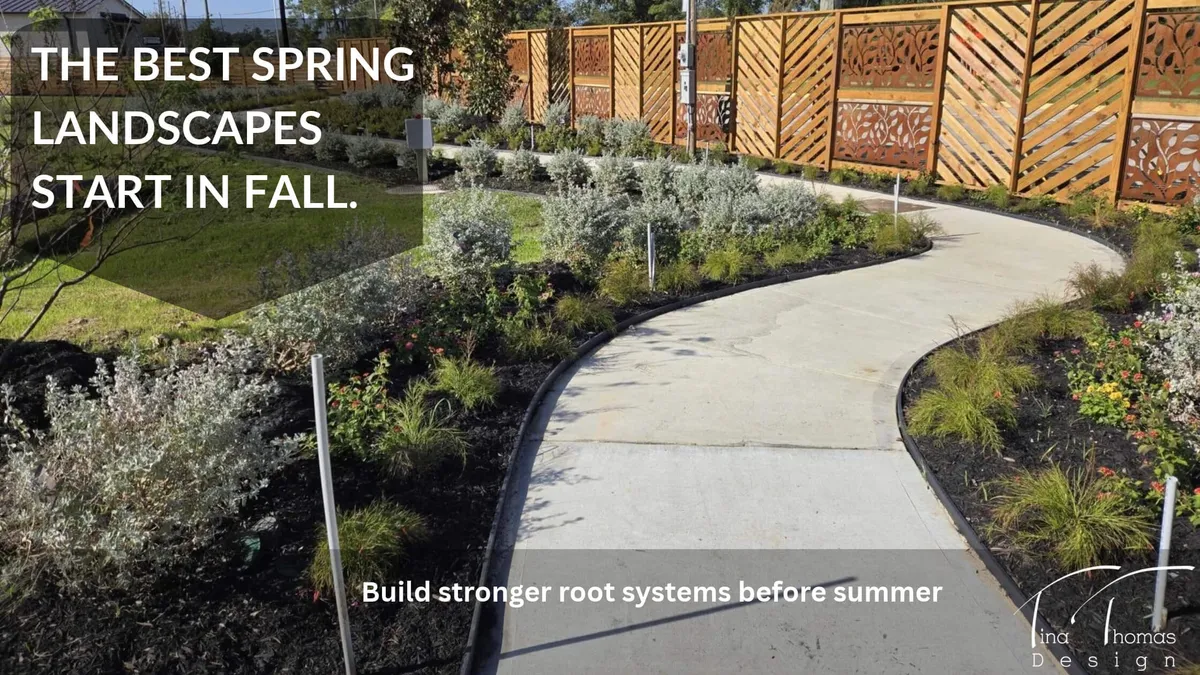
Fall Landscaping in Texas: Why Autumn Is Ideal
When most people think about landscaping, they think spring.
Nurseries fill with new plants, homeowners start outdoor projects, and properties seem to come alive after winter. But in Texas, waiting until spring to make major landscape improvements is not always the best strategy.
Our climate changes the equation.
By the time many spring landscapes are installed, intense Texas heat is not far behind. Newly planted trees, shrubs, and perennials may have only a short window to establish themselves before facing high temperatures, greater water demands, and periods of drought.
That is why September and fall can be some of the smartest times to invest in your landscape.
For homeowners, fall provides an opportunity to create a healthier, more established landscape before the next growing season. For real estate investors, developers, and property owners, it can also be a strategic property improvement—strengthening curb appeal, protecting landscaping investments, and preparing the property to make a stronger impression in spring.
The goal is not simply to make the property look better today.
It is to create a landscape that performs better over time.
Cooler Air + Warm Soil = Better Establishment
One of the biggest advantages of fall planting in Texas is what is happening beneath the surface.
As daytime temperatures become more moderate, plants experience less heat stress. At the same time, the soil can remain warm enough to support continued root development.
That combination gives many trees and shrubs an important opportunity: they can devote energy to establishing roots before the stress of another Texas summer arrives.
Texas A&M Forest Service emphasizes that successful tree establishment depends heavily on appropriate planting, soil conditions, moisture management, and proper watering. Establishing a strong root system early gives a tree a much better opportunity to thrive over the long term.
That matters because healthy landscaping is not simply about what you see above ground.
The stronger the root system, the better equipped a plant is to tolerate heat, changing weather conditions, and periods of limited rainfall.
For property owners, that can also mean protecting the money already invested in plant material, installation, irrigation, and maintenance.
A landscape that must constantly be replaced is not a good investment.
Plant in Fall. Look Better in Spring.
There is another advantage to thinking ahead.
A landscape installed in fall has time to begin settling into the property before spring arrives.
Instead of waiting until March or April and trying to create an instant transformation, property owners can use fall to establish the structural elements of the landscape first.
By spring, those plants are no longer brand-new additions competing immediately with rising temperatures.
The result can be a landscape that feels:
More established
More cohesive
Better integrated with the architecture
More intentional
Better prepared for seasonal color
For homeowners, that means enjoying a more mature-looking outdoor environment.
For investors and property owners, it can mean something equally important: stronger curb appeal when prospective residents, buyers, or tenants begin evaluating the property.
The exterior is often the first experience someone has with a property.
Before they walk through a lobby, tour an apartment, or enter a home, they have already formed an impression from the approach, landscaping, entry sequence, parking areas, sidewalks, and outdoor spaces.
Strategic landscaping helps make that first impression feel intentional rather than neglected.
Start With Trees and Shrubs, Not Flowers
Seasonal color gets attention, but it should not carry the entire landscape.
The strongest landscapes begin with structure.
Trees and shrubs form the framework that gives the property shape throughout the year. They can:
Frame entrances
Define pedestrian areas
Soften large architectural surfaces
Add privacy and screening
Provide shade
Direct sightlines
Create transitions between buildings and outdoor spaces
Give planting beds year-round visual weight
For a multifamily property, for example, strategically placed trees may improve shade around walking paths, amenity spaces, parking areas, or gathering zones.
Shrubs can soften building foundations, define entrances, screen utilities, or create separation between public and more private spaces.
On a single-family property, the same principles apply at a different scale.
This is why landscape decisions should begin with questions such as:
What needs to be framed?
Where is shade needed?
What should be screened?
Where does the architecture need softness or balance?
Which areas need year-round interest?
Only after that framework is established should seasonal color become the finishing layer.
Curb Appeal Is Part of the Asset
For an investment property, landscaping should not be viewed simply as decoration.
It is part of how the asset is experienced.
A tired landscape can make a perfectly good property feel dated or poorly maintained. Conversely, thoughtful landscaping can help an older property feel refreshed before major architectural work ever begins.
That distinction matters.
Residents and buyers do not evaluate properties exclusively by square footage or finishes. They respond to the overall experience.
Does the entrance feel welcoming?
Does the property appear maintained?
Are outdoor areas inviting?
Does the landscape complement the architecture?
Does the property photograph well?
Does it feel like somewhere people would want to live?
Landscaping contributes to all of those impressions.
And fall provides an opportunity to make those improvements proactively rather than scrambling to create curb appeal immediately before leasing, selling, refinancing, photographing, or marketing the property.
Do Not Overlook the Finishing Touches
A fall landscape strategy does not necessarily mean replacing everything.
Sometimes the biggest visual improvement comes from refining what is already there.
September is an excellent time to walk the property and evaluate the details that often get overlooked.
Refresh the Mulch
Fresh mulch creates an immediate sense of order and gives planting beds a finished appearance.
But mulch is not merely cosmetic.
Texas A&M's Earth-Kind landscaping guidance notes that mulch helps conserve soil moisture, reduce evaporation, moderate soil temperatures, suppress weeds, and support plant establishment.
Texas A&M Forest Service recommends applying mulch around trees while keeping it away from direct contact with the trunk.
That small detail matters.
The goal is to protect the root zone—not create the familiar “mulch volcano” piled against the trunk.
Repair Bed Edging
Few improvements are as simple—or as visually effective—as clean landscape edges.
Defined edges help separate lawn, planting beds, pathways, and other materials. They create the visual organization that makes landscaping feel professionally maintained.
This becomes particularly important on larger properties where inconsistent edging can make the entire landscape feel less cared for.
Evaluate Landscape Lighting
A property does not stop communicating after sunset.
Landscape lighting can highlight architectural elements, illuminate trees, improve pathway visibility, define entrances, and extend the usability of outdoor amenity spaces.
For multifamily and mixed-use properties, lighting also contributes to the evening arrival experience.
The goal should not be excessive brightness.
Good landscape lighting should feel integrated, purposeful, and supportive of both the architecture and the way people move through the property.
Check the Irrigation System
One of the worst mistakes a property owner can make is installing new landscaping without evaluating how it will be watered.
Fall may reduce some irrigation demands, but new plants still require consistent moisture while their root systems become established.
Texas A&M Earth-Kind guidance emphasizes efficient irrigation and recommends evaluating systems to reduce unnecessary water use. Drip and other low-volume irrigation methods can be particularly effective because water can be delivered closer to plant root zones instead of being lost through inefficient application.
For an existing irrigation system, look for:
Broken or misaligned sprinkler heads
Leaks
Overspray onto sidewalks or buildings
Areas receiving too much or too little water
Poor scheduling
Changes in the landscape that have made the original irrigation design ineffective
The objective is not simply to use more water.
It is to use water intelligently.
Landscaping Should Begin With a Plan, Not a Shopping Cart
One of the easiest ways to waste money on landscaping is to start at the nursery.
A plant catches your eye.
You bring it home.
You find an empty place for it.
Then six months later, you discover that it receives too much sun, grows far larger than expected, requires more water than the rest of the bed, or simply does not work with the architecture.
Repeat that process enough times and the landscape becomes a collection of individual plants rather than a cohesive design.
A better approach starts with the property itself.
Before selecting plants, ask:
What is the long-term purpose of this area?
What should someone notice when approaching the property?
Where is shade needed?
Which views should be emphasized?
Which views should be screened?
Where does the architecture need more softness?
What maintenance level is realistic?
How much irrigation will the landscape require?
Which existing plants should remain?
Which improvements will create the greatest visual impact?
Texas A&M's Earth-Kind principles similarly encourage landscape planning that considers design, plant selection, irrigation, soil conditions, and long-term resource use rather than treating each decision separately.
That is the difference between adding landscaping and designing a landscape.
Think Spring Starts in Fall
Texas property owners have a tremendous advantage in fall: time.
Time for roots to establish.
Time to evaluate what worked during summer.
Time to improve irrigation.
Time to strengthen the structural landscape.
And time to make thoughtful decisions before the urgency of spring arrives.
For homeowners, fall improvements can create a healthier and more enjoyable outdoor environment.
For developers, multifamily owners, and real estate investors, the opportunity goes further.
Strategic landscaping can strengthen the arrival experience, elevate curb appeal, support outdoor amenities, complement the architecture, and help the property feel better maintained and more competitive.
So before heading to the nursery this September, look at the property as a whole.
Do not begin by asking:
“What should we plant?”
Begin with:
“What does this property need to become more beautiful, functional, resilient, and valuable?”
Great landscapes start with a plan.
And in Texas, some of the best spring landscapes actually begin in fall.
References
Texas A&M Forest Service: Tree Planting and Establishment Guidance.
Texas A&M AgriLife Extension – Earth-Kind Landscaping: Landscape planning, water conservation, irrigation, and mulch guidance.
Texas A&M AgriLife Extension – Earth-Kind: Efficient Use of Water in the Garden and Landscape.

The Story Behind The Style

My love for architecture and design comes from the joy of creating spaces that truly speak to people and create a feeling the moment you walk in. Rather than gravitating toward one specific style, we focus on designing spaces that reflect the people who live, work, and gather within them. Whether the end result feels vintage, modern, eclectic, or somewhere in between, the goal is always the same — to create spaces that feel intentional, personal, and memorable.
Ready To Elevate Your Property?
COMPANY
SUPPORT
LEGAL
FOLLOW US


© Copyright 2026. Powered by Dealey AI Strategies. All Rights Reserved.